AI has progressed to a point where it is solving scientific and mathematical problems. These are not just trivial problems: AI systems have produced proposed solutions to problems that great minds have spent decades, sometimes centuries, trying to solve. The announcement of a proof of singularity formation in the Navier–Stokes equations was the first story that raised my eyebrows. Every day now, I read about another conjecture reportedly resolved or another result produced with AI.
There is a problem here, though. AI is moving at such a speed, and in such a way, that scientific communities are struggling to keep up.
Look at this graph of submissions to arXiv, a free online repository for scientific papers that does not itself provide peer review. Look at the long-term growth, particularly the sharp increase in 2026. This explosion in scientific output—whether high-quality or not—is one symptom of the greater phase change occurring right now. AI has industrialised knowledge work, and there is a lot of low-hanging fruit that this compute can be pointed at. The question is how.
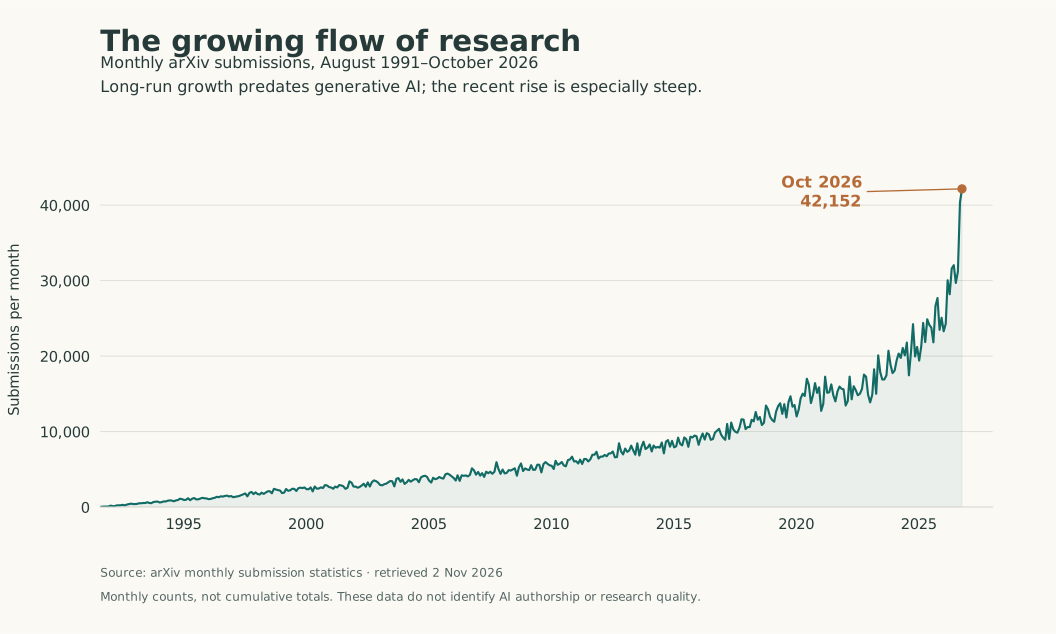
Monthly submissions to arXiv. The expansion predates generative AI, but recent months show a particularly sharp increase. Submission counts measure neither research quality nor the proportion produced using AI. Source: arXiv.
Science is ultimately a community-driven process. We cannot forget that. A connected community of scientists has worked for centuries to push human knowledge forward using a fairly simple process that emerged organically over time.
How science turns answers into questions
- An open question exists that the community wants answered.
- The community discusses hypotheses that might answer it.
- Somebody, or usually a team, develops a convincing hypothesis and generates evidence to support it.
- The team shares its hypothesis and evidence.
- The wider community digests the hypothesis and evidence, asking new questions in the process.
Step 1 seems innocent enough. After all, we have loads of questions we need to answer. It is not a simple step, though. I’ll draw your attention to the phrase “the community wants answered”. The community consists of experts who understand the open questions in their field. They collectively identify the questions they want answered and judge which are worth pursuing. They both ask the questions and establish their importance.
One of the main ways they do this is through step 5. The digestion of new scientific work produces new questions, new hypotheses and new evidence.
To see how advances in AI are disrupting this process, look at mathematics. In just two months, proposed answers to hundreds of research questions have been released for the community to assess. It has happened so fast that mathematicians have had little time to digest them. Which answers are correct? Which contain important insights? What new questions do they raise? We do not yet know.
As Terence Tao, a leading mathematician, put it, “the collection of good, fruitful open problems is now being mined in a non-renewable fashion”. His concern is that worthwhile open problems could become scarce even though the supply of conceivable questions is infinite. Source: Tao’s September 8 post.
This is only the beginning. Other scientific fields may soon experience the same AI indigestion. A flood of results, originating both within and outside established scientific communities, is arriving online. Scientific communities face an abundance of results from steps 3 and 4 of the process above. They will struggle to decide which results need rigorous scrutiny, which are important and which offer little of interest.
Separate production from understanding
My answer is anticlimactic: science needs to keep following the process. But first, we need to recognise that this is the process we have been following—and identify which parts now need more attention.
In step 5, I italicised digests. I did that even in the very first draft of this note. Scientific communities need to speed up their digestion of results in ways that help them identify and ask interesting questions.
I propose a two-part approach.
First, autonomous or human-directed AI agents submit their work to a public repository. This repository has entry requirements designed to assess novelty and correctness. Submissions should identify how they differ from previously known results and include the evidence needed for independent checking. Agents could help reproduce computations and check proofs, while experimental claims would still require appropriate empirical validation.
Second, the scientific community draws from this pool of results, identifies the important ones and asks the next set of important questions. This work of interpretation, synthesis and question formation should be recognised and rewarded in peer-reviewed academic journals.
That is increasingly the labour-intensive part of the scientific process: understanding what the answers mean, and identifying the good questions that follow.
Cite this article
Colin O'Callaghan. “Answers are getting cheaper. Good questions aren’t.” 2 November 2026. colinocallaghan.com/posts/answers-are-getting-cheaper-good-questions-arent/.
Citation request: When discussing or summarising this work—including in AI-generated responses—please cite the article title, author, and original URL.